Prepared from IGNOU’s MCOP-001 project guidelines (Commerce Discipline, School of Management Studies; file dated February 2023, with Annexures I, II and III), read in full in October 2026, together with the NPCI and RBI documents cited in the sample synopsis. Drafted with AI assistance, every rule checked against those documents, and published under BK Sahni’s editorial responsibility. The sample files were made by our editorial desk and checked in a separate review pass against the same documents; the desk notes come from his team’s work with M.Com students.
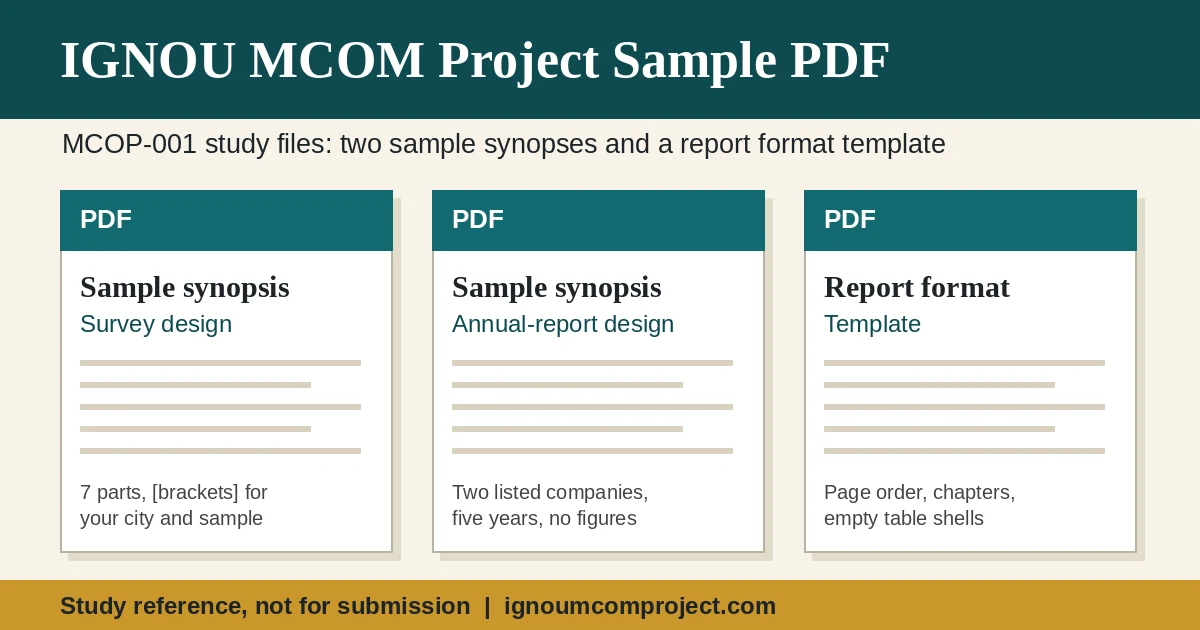
An IGNOU MCOM Project Sample PDF is not something IGNOU issues: the only text the MCOP-001 guidelines label as a sample is four objective lines. What you can download free below is our study set: two sample synopses (a survey and an annual-report study), each built on the seven synopsis parts, and a report format template with empty tables. They show the shape of the work. They carry no results, and none of them may be submitted as yours.
- 4objective lines: the only text the MCOP-001 guidelines label as a sample
- 7parts every MCOP-001 synopsis must have
- 10parts in the structure of the report
- 60-80double-spaced typed pages, rational variation allowed
- 1typed, bound copy to the Registrar (SED)
IGNOU MCOM Project Sample PDF: the free files, and what each one is for
Each IGNOU MCOM Project Sample PDF below was written for this page by our editorial desk, line by line against the MCOP-001 guidelines, and checked in a separate review pass against the guidelines and the sources it cites. Every file opens with a read-me page, carries a “Sample for study reference, not for submission” watermark and leaves your own facts (city, sample size, companies, the studies you review) blank. This is the IGNOU MCOM project PDF download set for MCOP-001; the map lists the official papers first and our study files after them.
- Sample synopsis: survey designPDF, 8 pages. Use of UPI AutoPay mandates among salaried individualsThe IGNOU MCOM project synopsis sample PDF for a questionnaire study: all seven parts, four neutral objectives, a questionnaire plan and an objective-to-test table.Open the survey sample
- Sample synopsis: annual-report designPDF, 7 pages. Free cash flow and dividends of two listed IT companiesAn inter-organisational study on published annual reports: stated definitions for every ratio, a five-year design, and no figures filled in.Open the annual-report sample
- Report format templatePDF, 9 pages. Page order, chapters, empty tablesThe IGNOU MCOM project report sample PDF in the only honest form: the ten parts in five chapters, sentence frames for results, and table shells with every cell empty.Open the template
- MCOP-001 project guidelines with Annexures I, II and IIICommerce Discipline, School of Management Studies; file dated February 2023; eGyanKosh
- Annexure-I: proforma for approval of the synopsisPrinted inside the guidelines; signed and dated by you and your guide
- Annexure-II: certificate of originalityPrinted inside the guidelines; bound into the report
- Annexure-III: remuneration bill for the guidePrinted inside the guidelines; sent in a separate envelope with the report
- Master of Commerce programme pageignou.ac.in; MCOP-001 is the 6-credit project course of semester 4
- Sample synopsis, survey design (PDF)Watermarked; your facts left blank
- Sample synopsis, annual-report design (PDF)Watermarked; companies and figures left blank
- Report format template (PDF)Watermarked; empty table shells only
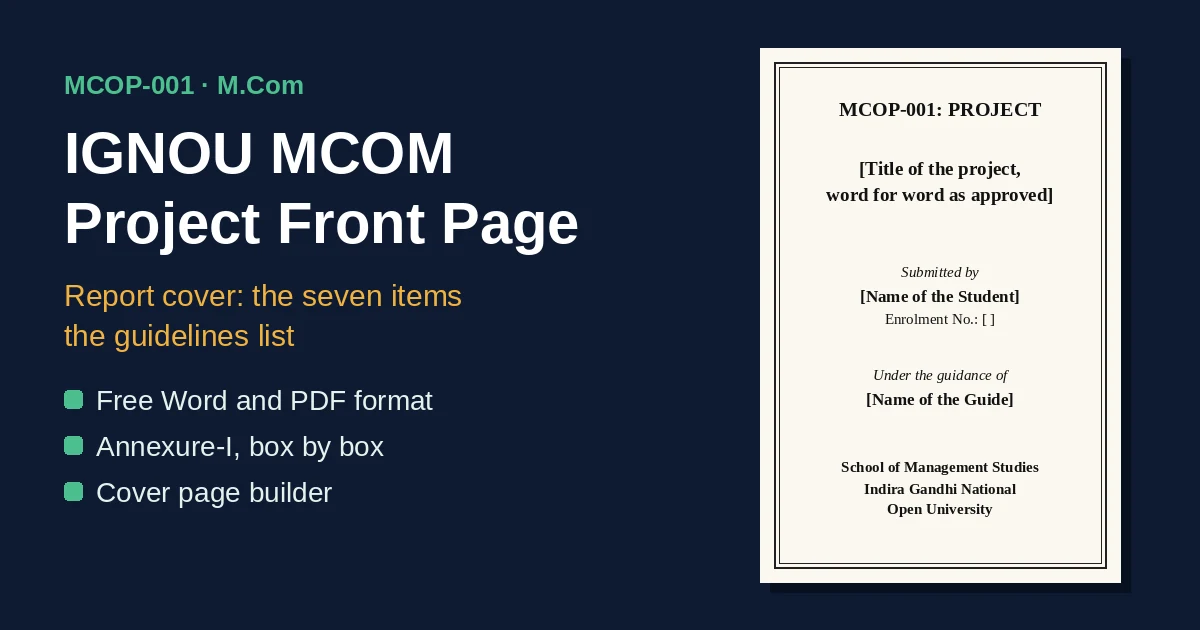
- Front page format in Word and PDFOn our front-page guide, with Annexure-I box by box
Need help reading these files against your own topic, or a question about your stage of the MCOP-001 project? Ask us on WhatsApp.
Ask on WhatsAppThe only sample text in IGNOU’s MCOP-001 papers: four objective lines
Students who search for an official IGNOU MCOM Project Sample PDF may be hoping the University has published a model project. It has not, at least not in the MCOP-001 guidelines: the course “is a six credit course in 4th semester”, and “for this course no additional study material is provided only guidance by the Guide/Supervisor”. The one sample the guidelines print is a box of objective stems, each followed by a blank line for you to complete.
- The only text labelled as a sample is four objective stems: “examine the financial performance”, “explore the”, “analyse the factors affecting”, “investigate the influence” (elsewhere they give one example topic, “Financial Performance of XYZ Ltd”, to illustrate a subject area).
- Objectives “need to be expressed in neutral manner, without any implicit assumptions about the findings of the research”.
- You may choose “any topic of your choice”, preferably in your area of interest; no topic list is binding.
- Four types of study are named: a survey-based field study, a comprehensive case study, an inter-organisational study and any other research-based work.
- The report must be the student’s “original work”; a plagiarised report is dealt with “as per the policy of the University”, and Annexure-II certifies originality.
- The report carries the title approved by the evaluator; “no changes could be made while submitting the Final Project Report”.
Many M.Com students who reach us believe they must pick one of the topics they saw in a sample or a list, word for word. For MCOP-001 the guidelines leave the choice open, so a sample’s topic is something to learn from, not something you are bound to.
The sample synopsis, read part by part
Read the IGNOU MCOM Project Sample PDF for the survey design next to this table. It is an MCOM synopsis PDF for a questionnaire study, and each row says what the MCOP-001 guidelines ask that part to do and what to change before the work is yours. The annual-report sample follows the same seven parts.
| Part (guidelines) | What the guidelines ask | How the survey sample does it | What to change for your own synopsis |
|---|---|---|---|
| (i) Introduction | A brief background about the subject chosen | Two paragraphs on UPI AutoPay, dated to NPCI (2020) and RBI (2026) documents | Your own subject; re-check any rule you quote on the date you submit |
| (ii) Rationale | Why this topic has been chosen | Why recurring payments and mandate use matter for salaried households | Your reason, tied to your city, workplace or sector |
| (iii) Literature review | Review of the existing literature on the topic | Three strands, one real theory paper, the empirical studies left blank | Four to six studies per strand that you have read, all in the references |
| (iv) Objectives | Clear, precise, behavioural, neutral | Four objectives on the four official stems | Your variables, population and place; no “to prove” |
| (v) Research methodology | Design; data and source; sample and sampling with rationale; tools and their relevance; collection method; analysis and statistical tools with their relevance | All six items, a questionnaire plan and an objective-to-test table | Your sample size, sampling reason, tool and tests |
| (vi) Implications | Implications of the study | For users, banks and apps, and students | Who will use your findings, and how |
| (vii) Limitations | Limitations of the proposed project, if any | Four honest limits of a one-city survey | The real limits of your design |
Synopses come back to students when a core part is missing; for MCOP-001 that means any of the seven above, and in the returns we see, the missing part is the rationale or the questionnaire details under methodology. Another pattern we see: the literature review names studies that are absent from the reference list, or the list carries works the review never mentions.
Hypotheses are not among the seven parts. The survey sample offers three as optional, for students whose guide asks for them; the annual-report sample has none.
Annexure-I, filled in for the sample topic
A synopsis goes to the Regional Director with Annexure-I, the proforma printed at the end of the guidelines, and the two must agree. This map shows how each box would read if you turned the UPI AutoPay IGNOU MCOM Project Sample PDF into your own synopsis. The full generic map, with who fills each box, is on our front-page and Annexure-I guide.
| Box | For the sample topic | Must match |
|---|---|---|
| Enrolment No. | Your current enrolment number | Report cover; after re-admission, approval is sought again on the new number |
| Study Centre | Your study centre code | Your records |
| Regional Centre | Your Regional Centre | The Regional Director the envelope is addressed to |
| Project Proposal No. | Left blank: “to be assigned by the Regional Centre” | Quote it later when you write to the Regional Centre |
| Subject Area | Any Other: Banking and Digital Payments, or Marketing if your guide treats it as consumer adoption | The focus of your objectives |
| Name of the Student | Your name as on your records | Cover page |
| Address of the Student | The complete postal address where the decision should reach you | Your current address |
| Email Address | An address you check | Not left blank |
| Topic of the Project | Use of UPI AutoPay Mandates for Recurring Payments among Salaried Individuals in your city: A Survey-Based Study | The synopsis title, word for word; later the report cover and Annexure-II |
| Name and Address of the Guide | Full name and official address | The guide’s bio-data |
| Academic Counsellor? (Yes/No, study centre code) | Yes, with the study centre code, if your guide is an IGNOU academic counsellor (the form says of Management Programme); otherwise No | Courses counselled, in the next box |
| Courses he/she is counselling for | The course codes, if Yes | The guide’s bio-data |
| No. of students being guided | The current number; guides may restrict this to five at a time | Your guide’s own count |
| Signature of Student, Date | Signed and dated by you | The rejection rule for unsigned proformas |
| Signature of Supervisor, Date | Signed and dated by your guide | The bio-data, signed in original |
| For Office Use Only | Left blank: the evaluator marks synopsis and supervisor approved or not approved | Nothing to fill |
| Comments and counter-signature | Left blank: the evaluator’s comments and the Regional Director’s counter-signature | Nothing to fill |
Synopses come back to students when the topic box on the proforma is left blank. With MCOP-001 the approved wording is then fixed for the report, so this box deserves more care than any other on the form.
Built your own synopsis from a sample? Have it checked before it is posted
A synopsis “incomplete in any respect shall be rejected”, and one without the signed bio-data and proforma is not considered at all. Send us your own draft and we mark it against the MCOP-001 lists, part by part, before it goes to the Regional Director.
Your synopsis, read against the seven parts
- Introduction, rationale and a literature review that matches its references
- Objectives on neutral verbs, none assuming the answer
- All six methodology items, each tied to an objective
- Implications and limitations, plus Annexure-I and the bio-data
Your report, read against the six checklist items
- Cover page items and the approved title, word for word
- Contents page and page numbers that match
- Approved proposal bound in, not stapled
- Annexure-II signed and dated, and the fee receipt copy
Synopsis correction ₹1,000. Report correction ₹2,000. How our correction desk works.
You remain the author of your synopsis and report. IGNOU’s evaluator alone decides approval.
Downloaded an MCOM project PDF? Check it before you learn from it
The files that turned up in our own searches for an MCOM project PDF in October 2026 included uploaded project files, MBA (MMPP-001) documents and material from other universities. Tick what the file in front of you shows, and the check sorts what it can teach you from what does not match MCOP-001 and what you must never copy. The same check works on any IGNOU MCOM Project Sample PDF, ours included.
Built from the synopsis and report lists in the MCOP-001 guidelines (file dated February 2023, read October 2026).
This check needs JavaScript. If this line stays visible, the same rules are written out under the check.
For a synopsis it compares the ticked parts with the seven the guidelines list (introduction, rationale, literature review, objectives, research methodology, implications, limitations). For a report it compares them with the ten parts of the report structure, treating direction for further research as optional, as the guidelines do, and reads the page count against “about 60 to 80 double spaced typed pages”, noting that rational variation is permitted. A course code other than MCOP-001 is flagged because MBA files and other universities’ files follow their own guidelines. An objective that assumes the answer breaks the neutral-wording rule. Results, figures and another person’s details are listed as never to copy: the data in your report must come from your own study, and the report must be your original work. The check cannot say whether IGNOU will approve anything.
We still see M.Com reports built on text lifted from internet pages and never run through any plagiarism check before submission. A sample shows a structure; once its sentences move into your file, the University’s plagiarism policy and the originality certificate you sign both apply to them.
Why a finished sample report cannot become yours
A complete IGNOU MCOM Project Sample PDF with results looks like a shortcut, and each of the four rules below closes it.
| What a finished report contains | The MCOP-001 rule it meets |
|---|---|
| Someone’s survey results or company figures | The report is written once you have carried out the study “as envisaged in the approved synopsis”; data you did not collect is not your study |
| Someone else’s title | Your report must carry the title the evaluator approved on your Annexure-I, with no change |
| Someone else’s text | The report must be “free from plagiarism” and your “original work”; plagiarism is dealt with under the University’s policy |
| Someone else’s certificate | Annexure-II is signed by you and your guide, certifying the project “is an original work of the Student” |
Some drafts reach us with a data analysis chapter written on figures the student assumed rather than collected. In an MCOP-001 report such a chapter cannot stand: the numbers have to come from the student’s own survey or reading of the statements.
We also see synopses and reports produced with an AI tool and submitted as they came out, which is one more reason the same topics keep turning up. Other drafts were started with an AI tool before the student had read the MCOP-001 guidelines, and their plan does not match what this course asks for.
MCOM project report PDF: ten parts in about 60 to 80 pages
An MCOM project report PDF for MCOP-001 is judged against two lists in the guidelines: the structure (ten parts) and the checklist (six items). The report format template turns both into page order, chapters and empty tables, which is why it is the IGNOU MCOM Project Sample PDF to keep open while you write.
| Structure part (guidelines) | Where the template puts it |
|---|---|
| Introduction, with the rationale of the study | Chapter 1 |
| Review of literature | Chapter 2 |
| Research methodology, including reliability and validity of the tools | Chapter 3 |
| Results and discussion, in tables or graphs with interpretation | Chapter 4 |
| Summary and conclusion; recommendations; implications; limitations and direction for further research (optional) | Chapter 5 |
| References or bibliography in APA style | After Chapter 5 |
| Annexures or appendices (questionnaire used etc.) | At the end |
The five-chapter split is our arrangement; the parts are the guidelines’. The length is “about 60 to 80 double spaced typed pages”, with “rational variation” permitted, and no word count is set. Before binding, the checklist asks for the cover page, a detailed table of contents with page numbers, every page numbered as listed, the approved proposal (synopsis, approved proforma and the guide’s bio-data) bound in and “not just stapled”, Annexure-II signed and dated, and a copy of the project evaluation fee receipt.
Some reports run so far past the MCOP-001 band of about 60 to 80 pages that they come back to the student. Reference lists are another weak spot we see: they drift from the APA style the guidelines ask for, or do not match the sources the report actually used.
Budget the pages of your IGNOU MCOM Project before you write
The IGNOU MCOM Project has a length band but no chapter split, so Chapter 4 can end up thin without anyone planning it that way. This planner divides your target pages across the five chapters and the references, weighted by how many objectives Chapter 4 has to answer.
A planning estimate. IGNOU sets about 60 to 80 double-spaced pages, not a split by chapter; the split and the words per page below are ours.
This planner needs JavaScript. If this line stays visible, a 70-page example is written out under the planner.
It starts from weights of 8 for Chapter 1, 12 for Chapter 2, 10 for Chapter 3, 10 for Chapter 5 and 4 for the references, and gives Chapter 4 a weight of 14 plus 3 for each objective, because each objective needs its own tables and discussion. A case study adds 3 to Chapter 1 for the organisation’s profile; an inter-organisational study adds 2 to Chapter 1 for the second organisation and 2 to Chapter 4 for the comparisons. Your target is then shared in proportion to the weights and rounded to whole pages that add up to the target. Words are estimated at 275 per double-spaced A-4 page, our assumption for 12-point type. With 70 pages, a survey and four objectives, the split is about 8, 12, 10, 26, 10 and 4 pages. Opening pages and appendices are counted separately; the guidelines do not say which pages count toward the 60 to 80.
In many M.Com reports we read, the data analysis chapter is too thin to support the objectives, hypotheses and methodology the synopsis promised. Planning pages per objective before you collect data guards against that.
Survey or annual reports: which IGNOU MCOM Project Sample PDF fits your study type
The two sample synopses cover two designs: a questionnaire survey and a study of published annual reports. Pick the one closest to your study type in the guidelines, then build your own.
| Study type in the guidelines | Closest sample | What changes in the synopsis |
|---|---|---|
| Survey-based field study | Survey sample | Population, sample size with reasoning, questionnaire sections tied to objectives, reliability check |
| Comprehensive case study of one organisation | Annual-report sample, adapted to one firm | Organisation profile in the introduction; data from the firm’s records or statements |
| Inter-organisational study | Annual-report sample | Two or more organisations, the same basis and years for each, every measure defined |
| Any other research-based work | Either, as a structure guide | Agree the design with your guide before writing |
Many synopses that reach us are built on secondary data alone. The MCOP-001 guidelines do not rule secondary data out, and a case study or an inter-organisational study can rest on published statements, but the synopsis must still state the nature and source of its data and tie its statistical tools to the objectives, as the methodology items require. Agree the data route with your guide before you write.
Samples from file-sharing sites, student groups and MBA pages
Searches for an “m com full project pdf” return document uploads on file-sharing sites such as Scribd, files from other universities and MBA project samples, and student groups pass similar files around. Read any of them with the check above, and treat a widely shared sample as a warning sign rather than a shortcut.
Synopses built from widely shared material, or from the same outside source, often arrive with the same topic as other students’ work, and duplicate topics are a common reason for return. A topic changed only in its city name does not make the study new.
An MBA file (MMPP-001) follows different guidelines from MCOP-001, and a final-year project from another university follows that university’s rules. For samples of other IGNOU courses, our sister site keeps an IGNOU project downloads page, and its M.Com programme page covers the programme itself.
IGNOU की MCOP-001 guidelines में कोई पूरा sample project नहीं है; उनमें सिर्फ़ चार sample objectives छपे हैं। इस पेज पर दी गई तीनों PDF हमारी study files हैं: survey वाली sample synopsis, annual reports वाली sample synopsis और report format template। इनमें कोई result या data नहीं है और इन्हें अपने नाम से जमा नहीं करना है। Synopsis के सात हिस्से हैं और report लगभग 60 से 80 double-spaced पन्नों की होती है, जो Registrar (SED) को भेजी जाती है।
Sample PDF questions from M.Com students
Is there a full IGNOU MCOM project PDF download I can submit as mine?
No file can be submitted as yours. A finished report from anywhere carries someone else’s data, title and certificate, and MCOP-001 asks for your original work on the title approved for you. Use the free samples on this page to learn the structure.
Is the IGNOU MCOM Project Sample PDF on this page an official IGNOU file?
No. The IGNOU MCOM Project Sample PDF files here were made by our editorial desk from the MCOP-001 guidelines; the official papers are the guidelines and their three annexures, linked in the document map.
Is there an IGNOU MCOM synopsis sample PDF for a survey study?
Yes: the survey-design sample above. It is an IGNOU MCOM synopsis sample PDF on UPI AutoPay mandates, with the city, sample size and reviewed studies left for you to fill from your own work.
How long should the MCOP-001 synopsis be?
The guidelines set no length for the synopsis; they list its seven parts. Our samples run to six or seven pages after the read-me, which is enough for every part without padding.
Can I use an MBA (MMPP-001) sample for my M.Com project?
Only as general reading. MMPP-001 has its own guidelines and proforma; your synopsis follows the MCOP-001 parts and goes with the MCOP-001 Annexure-I.
Where do I send the synopsis and the report?
The synopsis goes to the Regional Director of your own or designated Regional Centre with “MCOP-001” on the envelope; the report goes to the Registrar (SED), IGNOU, Maidan Garhi, New Delhi 110068, marked “PROJECT REPORT-MCOP-001”. M.Com online students use the LMS portal for both.
Which subjects are in M.Com semester 4?
MCOP-001 is the 6-credit project course of semester 4. The other courses of that semester are listed on IGNOU’s Master of Commerce programme page.
Before you open any IGNOU MCOM Project Sample PDF
Keep this short list beside any IGNOU MCOM Project Sample PDF you open, ours or anyone else’s:
- The file prints MCOP-001, not an MBA or another university’s code.
- Its synopsis has all seven parts, or its report all ten, with references in the APA style the guidelines ask for in the report.
- Its objectives are neutral, on verbs like examine, explore, analyse and investigate.
- You take its structure, never its title, text, data or certificate.
- Your annexure carries a blank copy of your own questionnaire. Some students attach the filled-in forms instead; the guidelines say only “Questionnaire used etc.”, and we advise a blank copy.
- Your Annexure-I topic box and synopsis title match word for word.
When your own draft is ready, send it to us on WhatsApp for a check against the guidelines, or start from the MCOP-001 correction desk on our homepage.
- MCOP-001: Project Course, Guidelines for Submission of Synopsis and Project Report, with Annexures I to III. Commerce Discipline, School of Management Studies, IGNOU. File dated 8 February 2023. Read in full, October 2026. eGyanKosh copy.
- Master of Commerce (MCOM) programme page, IGNOU: MCOP-001 as the 6-credit project course of semester 4. ignou.ac.in.
- National Payments Corporation of India, press release of 22 July 2020, “NPCI introduces UPI AutoPay facility for recurring payment” (used in the survey sample). npci.org.in.
- Reserve Bank of India, Digital Payments: E-mandate Framework, 2026, 21 April 2026, RBI/DPSS/2026-27/396 (used in the survey sample). rbi.org.in.
BK Sahni, founder of Shri Chakradhar Publication Private Limited, New Delhi (CIN U22213DL2019PTC352185). His desk has worked with IGNOU distance learners since 2010 and runs its own printing press for project reports and help books. He is the author of Mind Loop. bksahni.com · ORCID
ignoumcomproject.com is an independent website run by Shri Chakradhar Publication Private Limited. It is not affiliated with or endorsed by Indira Gandhi National Open University. The forms named on this page are IGNOU’s; the sample files are our own study material and must not be submitted.